

Pinned Post
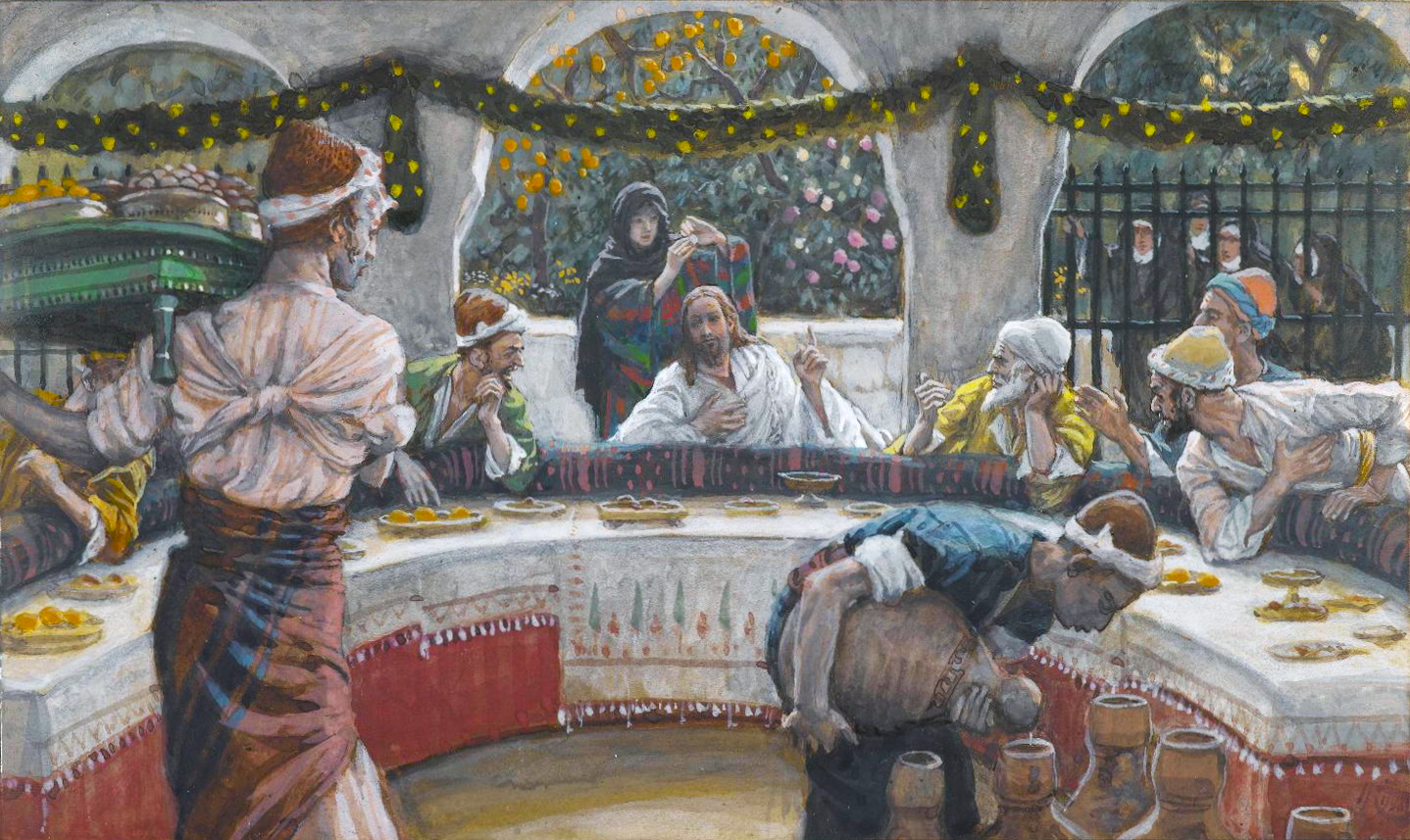
James Tissot, 1886-96
Translation the Epistle for the Sixteenth Sunday after Pentecost (Eph. 3:13-21)
Brethren: I pray you not to be disheartened at my tribulations for you, for they are your glory. For this reason I bend my knees to the Father of our Lord Jesus Christ, from Whom all fatherhood in heaven and on earth receives its name, that He may grant you from His glorious riches to be strengthened with power through His Spirit unto the progress of the inner man; and to have Christ dwelling through faith in your hearts: so that, being rooted and grounded in love, you may be able to comprehend with all the saints what is the breadth and length and height and depth, and to know Christ’s love which surpasses knowledge, in order that you may be filled unto all the fullness of God. Now, to Him Who is able to accomplish all things in a measure far beyond what we ask or conceive, in keeping with the power that is at work in us – to Him be glory in the Church and in Christ Jesus down through all the ages of time without end. Amen.
Continuation of the Holy Gospel According to St. Luke (14:1-11)
At that time, when Jesus entered the house of one of the rulers of the Pharisees on the Sabbath to take food, they watched Him. And behold, there was a certain man before Him who had the dropsy. And Jesus asked the lawyers and Pharisees, saying, Is it lawful to cure on the Sabbath? But they remained silent. And He took and healed him and let him go. Then addressing them, He said, Which of you shall have an ass or an ox fall into a pit, and will not immediately draw him up on the Sabbath? And they could give Him no answer to these things. But He also spoke a parable to those invited, observing how they were choosing the first places at table, and He said to them, When you are invited to a wedding feast, do not recline in the first place, lest perhaps one more distinguished than you have been invited by him, and he who invited you and him come and say to you, ‘Make room for this man’; and then you begin with shame to take the last place. But when you are invited go and recline in the last place; that when he who invited you comes in, he may say to you, ‘Friend, go up higher!’ Then you will be honored in the presence of all who are at table with you. For everyone who exalts himself shall be humbled, and he who humbles himself shall be exalted.
The Saving Words of the Gospel.
They watched him assiduously.
In the Name of the Father, and of the Son, and the Holy Spirit. Amen.
Transcription of Homily
Ἦσαν παρατηρούμενοι αὐτόν (Êsan parateroúmenoi autón). They watched Him, well, closely; assiduously, and it could also be translated as insidiously. This verb form regards a certain observance of details. In religious life, it could be one’s vigilance over one’s interior and over the execution of God’s will. But here we see something of a demonic counterfeit in which they’re watching Our Lord insidiously, looking for something with which to accuse Him. We see in Scripture different types of people who watch Our Lord. There are those who watch out of curiosity, and nothing happens in their soul. There are those who watch Him and follow Him until it’s inconvenient. And then there are those, like we see in this Gospel, who are malicious in their observation of Our Lord, hoping to find something with which to accuse Him.
Our Lord doesn’t invite us to watch Him. He invites us to follow Him, and this following is obedience; this following is configuration with Him. So yes, it requires a vigilance of Him and a vigilance of our own hearts, but not some sterile, septic observance of Him that’s left on the externals. Sometimes people complain to me about how other people receive communion, and I’m thinking, “Well, you’ve just received communion yourself, and you’re complaining about others?! You’re not keeping your eye; you’re not observing Our Lord in your interior.” I wonder about the quality of those communions and if they’re having a great effect or not.
Our Lord heals this man who has dropsy; dropsy is a form of fluid retention in the body that creates great swelling. And some of the Church Fathers say that the reason Our Lord went from speaking, uh, well, from healing this man who had dropsy to speaking about pride and humility was because that the Pharisees had a sort of spiritual dropsy. They were inflated with their own self-love.
There’s a great old Jesuit spiritual writer, Father Nicholas Growl, who wrote a wonderful book I recommend called The Manual for Interior Souls. And he says those who have never sought to attain true mental humility are apt to imagine it impossible for mature and powerful minds, but in truth they’ve yet to learn how it lies at the root of all Our Dear Lord’s teaching and how it has ever been the path by which His saints have trod. When our mind and our hearts are not filled with self, we make space for Our Lord, and the Divine Spirit then inspires and communicates, invites us to greater intimacy to Him, but this requires humility. And there’s a humility that’s in the intellect; there’s another humility that’s in the will. Those are the two faculties that we have.
When God is operant in the intellect, there is a certain light that we enjoy that reveals the truth about Him and about ourselves, and it humbles us. And as it reveals something about ourselves, even our failings, especially our failings, when Our Lord is operant in the intellect, it doesn’t bring about despair or discouragement. There’s rather gratitude. Gratitude because Our Lord is showing us what it is He wants us to work on. Think of great figures in Scripture: how they were confronted with their own littleness before God’s invitation; when Moses was invited to carry out a certain task, and he felt very inadequate for it. Jeremiah certainly expressed how he was out of his league in what Our Lord was asking him to do. Isaiah, confronted with the utter holiness of God, is unsure of himself; Our Lady, before the Annunciation, reveals her own humility and says, Let it be done unto me according to Your Word. All of them didn’t just hear the message; they acted. They didn’t use their own inadequacy or the disproportion as an excuse not to do God’s will, but for the humble soul, he finds himself stretched, called to something that he never imagined Our Lord asking, and recognising that if our eyes are on Our Lord with great vigilance over our own hearts and minds, those great things come to fruition.
As the Holy Spirit elevates the intellect by these direct visitations, He infuses humility, and this is the tell-tale sign of His action. This humility then is the aperture through which He enters. It’s the foundation stone of the entire spiritual edifice. The self-contained person who lives on the surface can have no deep rapport with Our Lord, with Our Lord who longs to have an intimate communication with the soul. When Our Lord enjoins us to imitate Him, he doesn’t point to His intellect; He doesn’t point to His strength; His power; His purity; rather, to His own humility: Learn from me a meek and humble of heart. And so, this is where it all starts. And it’s what makes love possible.
Saint Bernard of Curvaux defines humility as a virtue by which a man, knowing himself as he truly is, abases himself. And Thomas Aquinas agrees. He says the virtue of humility consists in keeping oneself within one’s bounds, not reaching out to things above oneself, but submitting to one superior. At the root of the word humility is the Latin word humus, H_U_M_U_S_, which means earth, or it’s also where we get the word human; it’s where we got the word home, because the truly humble person is fully human; the truly humble person is at home wherever he is because of Our Lord and not because of the place. It’s a it’s an inner dwelling place.
Teresa of Avila, I won’t go into the long quote for the sake of time, but she says when the Holy Spirit’s acting on the will and calls us to greater humility, she says we don’t have to figure things out, because Our Lord will take charge and present us all sorts of opportunities with which to humble ourselves. She says if you want to be humble, Our Lord will take care of that. That’s one of those prayers that he answers quickly, and he gives us many opportunities for us to discover our own limitations and the great disproportion between who we are and who he is, and nonetheless to trust in Him.
St. Benedict wrote a treatise called the Twelve Steps of Humility, which I recommend. St. Bernard decided to update that, but he said I have more experience of pride than humility, so I’ll write my own little treatise called the Twelve Steps of Pride, and I recommend that as well. Both of them are spiritual gems, but St. Bernard juxtaposes the certain prideful attitudes with the attitude of a humble man. Now take into account that he’s writing for religious in a cloister, so this is just take into account the context.
He says, with regard to pride, the proud person is curious about other people’s business, whereas the humble person contains his own interests, reserving one’s attention for things that matter, with a humble bearing. Number two: pride brings about like-mindedness, chatter, superficiality, exclamations about things that don’t really matter, whereas the humble person is quiet and restrained in speech. Number three: the proud person laughs about silly things, and the humble person has self-control. Number four: boasting and talking too much about self or just talking too much, and the humble person doesn’t seek attention and is moderate in speech. Number five: the proud person tries to be different in order to be noticed. The humble person regards oneself as having no special rights in the community. Number six: thinking oneself holier than others, whereas the humble person knows himself to be less. Seven: the proud person interferes presumptuously in the affairs of others, whereas the humble person doesn’t take himself too seriously and doesn’t feel the need to fix everything and everyone. Number eight: the proud man justifies himself, defends even his own sinful actions, whereas the humble man confesses his sins with trust. Number nine: the proud man makes an insincere confession. The humble man is patient in the face of false accusation. Number ten: the proud man rebels against his superiors, whereas the humble man submits. Eleven: the proud man doesn’t feel constrained from sin, but feels free to do so, whereas the humble man sees God’s will as the way for his own will. And number twelve: habitually sinning with no mind to be converted, whereas the humble man is constant in his vigilance.
Our Lord will reveal Himself, aspects of Himself, aspects about ourselves, truths about the Son, truths about the deposit of faith, in as much as our minds and our hearts are humble. Humility doesn’t mean that we think ourselves less than we are; it accepts the limitations that we have. St. Augustine says the three most important virtues for the spiritual life are humility, humility, and humility. When Venerable Bede comments on this passage, he says for all of us to take the last place at a banquet- what does that mean? It means reining in proud considerations of ourselves and abasing ourselves before Our Lord and self.
So, rather than assiduously watching others, we ought to be vigilant over our own thoughts. We observe Christ not to watch Him merely as a sterile activity; we observe Christ to know Him and, in knowing Him, follow Him, and following Him being configured with Him who is meek and humble at heart.
In the Name of the Father, of the Son, the Holy Ghost. Amen.
~Fr. Ermatinger