
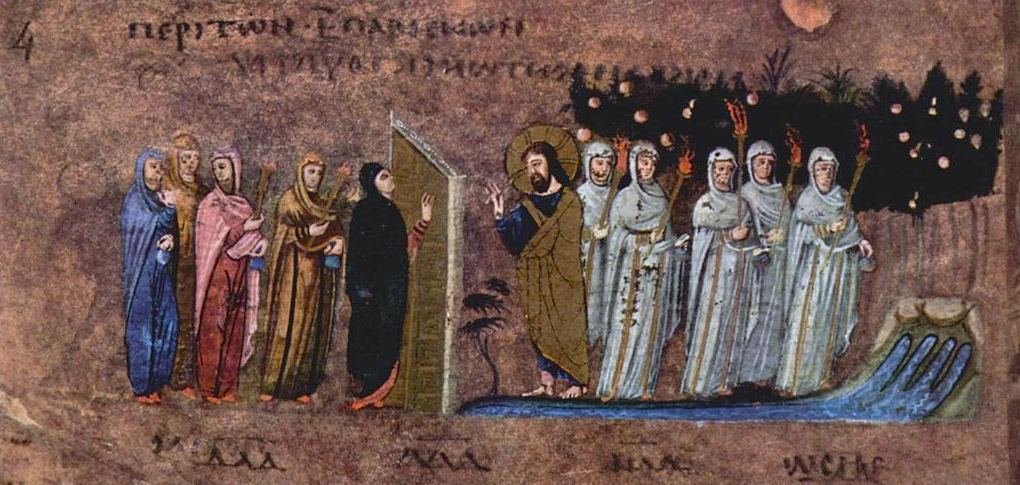
Rossano Gospel, 11th c.
Translation of the Holy Gospel for the Feast of St. Veronica Giuliani (Matt 25:1-12)
At that time Jesus spoke to his disciples this parable: The kingdom of heaven shall be like to ten virgins, who taking their lamps went out to meet the bridegroom and the bride. And five of them were foolish, and five wise. But the five foolish, having taken their lamps, did not take oil with them: But the wise took oil in their vessels with the lamps. And the bridegroom tarrying, they all slumbered and slept. And at midnight there was a cry made: Behold the bridegroom cometh, go ye forth to meet him. Then all those virgins arose and trimmed their lamps. And the foolish said to the wise: Give us of your oil, for our lamps are gone out. The wise answered, saying: Lest perhaps there be not enough for us and for you, go ye rather to them that sell, and buy for yourselves. Now whilst they went to buy, the bridegroom came: and they that were ready, went in with him to the marriage, and the door was shut. But at last come also the other virgins, saying: Lord, Lord, open to us. But he answering said: Amen I say to you, I know you not.
The Saving Words of the Gospel.
In the Name of the Father, and of the Son, and of the Holy Ghost. Amen.
Transcription of Audio
~Fr. Ermatinger
How many times in the Gospel of St. Matthew do we hear Our Lord speaking about the Kingdom, and the Kingdom is His great passion, it’s His great desire, the goal of His earthly mission, the reason for His suffering and death, and His rising. And what is the Kingdom? He says the Kingdom of Heaven shall be like the Ten Virgins, getting ready for their Bridegroom.
The Kingdom is full participation of man in the life of the Holy Trinity. Jesus says that the Ten Virgins went out to meet the Bridegroom, not a bridegroom, but the Bridegroom. He is the universal Bridegroom for whom each of our souls was created. In every language that has nouns in gender form, soul is always feminine. In German, Italian, Spanish, Latin, Greek, it’s always a feminine noun, because the soul is the recipient of grace. Christ is the Bridegroom; he’s not a bridegroom, just as He is the Son of Man. And He speaks about the Kingdom. The Prudent Virgins do not come to Our Lord waiting with half-measures. They’re ready for Him; they have been vigilant; they knew He was coming, and they’ve lived in accordance of that knowledge.
This “having the vessel full of oil” is the purpose of our community; to live with our vessels full, and that means not people who say prayers, but people who are prayerful. It should be an identity. This fullness, this fullness ought to be expressed in not just stipulated prayer times, but in having a heart and a mind set on the Bridegroom, having a heart and a mind habitually elevated, raised up looking towards Christ with great vigilance, and longing, and desire. To have “the vessel full of oil” means that there aren’t chinks in one’s spiritual armor, that there ought to be a burgeoning of virtues, and not a lopsided example of some virtues and some vices. And the only way we can overcome vices is not by fighting against them, but by replacing them with virtues. It makes no sense to fight against vice. It makes no sense to fight against temptation or sin. That goes nowhere. And it’s a very low bar anyway, to simply want to avoid vice. That’s not a noble cause.
But to truly reflect the image of the Bridegroom means that He’s taken possession of us. Just as Paul says, when he describes his own conversion, he says that Christ took possession of me, καταλαμβάνω (katalambanō) in Greek, which means to be taken possession of. And this then builds up, wells over in virtue, which we see in its height in the Beatitudes. If the Ten Commandments are a series of prohibitions, the Beatitudes are the height of the expression of the spiritual life. And so, this is what it means to have lamps full.
Obviously, taken for granted is the life of grace. That ought to be habitual without interruption. This eschatological encounter between the Bridegroom and the Virgins is the ancient representation from the Old Testament carried on through all of Scripture of this nuptial imagery that Our Lord has wanted to use to describe what He has in store for our souls. It’s nuptial imagery. Just as soul is feminine, alma, anima, seele, psyche. So, is Church feminine in every language that has genders. Iglesia, chiesa, ecclesia, kirche. Why? Because the Bridegroom is not just each one of us, it’s all of us, and each one of us. There is an individual call to Christ, but it’s in the context of the Church. It’s not something that is hyper-subjectivist on the margins of the Church, but it’s within the Church. And this is how we know that the ability to respond is also authentic, especially when it has to do with something along the lines of a community that has recognition by the Church.
When I first felt the call to found the Community, I met immediately with the Archbishop to see if this call was real. I liked my Sunday afternoons, and I thought if he says no, then I get to have my last Sunday afternoon of the month to myself. And I won’t complain if he says, ‘No, don’t do that.’ And he said, ‘Yes, I think this is of God, move forward.’ So, then we got approval. So, now I know the last Archbishop approved this Community, the present Archbishop has also given his approval that this is of God. And so, our task then is to live up to our commitments; these promises that we’re going to renew tonight.
Scripture begins with a wedding in Eden. In the first chapters of Genesis, in the last chapters of the Apocalypse, Scripture ends with a wedding. And this is the wedding of Christ and His Bride, the Church. And it says in Revelation 19 that the Church is adorned in the good deeds of the saints. And so, how beautifully adorned the Church is in eternity is something that we’re working out. How beautifully adorned is the wedding garment of the perpetual Church that will never cease to exist? How beautifully adorned with the good deeds of the saints, that’s something that’s still in flux. That’s something that each one of us is working out. And it doesn’t mean doing more things. It means doing what we do, what we commit to when we make our promises. It means doing those with all of our heart with lamps full as a consequence of having lamps full, and as a way of not just expressing the full lamps but even filling them more each time.
When I was studying for my licentiate in Rome, it struck me. I was doing a course on the development of the Symbol of Faith, the development of the Creed, how there were a series of creeds that the Church had promulgated, and there’s a certain theological development that one sees. And so, this was a course on that, and instead of just reiterating what the professor said on the exam, I thought I would just plagiarize from St. Thomas Aquinas and write down in my exam, the impending exam, whatever Thomas said. So, I read Thomas’ commentary on the Creed, and he starts off the commentary on the Creed by saying Credo – I believe.
To believe has four qualities. Faith has four qualities, one of which is akin to marriage. And I thought this was my discovery. I thought this was my idea. And then, I find out that in the thirteenth century, Thomas had preceded me. And of course, then going through the Church Fathers, finding that this is all over the writings of the Church Fathers, this notion of a nuptial relationship that God wants to have. You know, sometimes we moderns like to project things on God, and you know, say God is like a father. No, he is a father. Fathers, biological fathers here are like the Father. God is the Father. And we could also say that human marriage is also like the Trinity. Human marriage is like the relationship Our Lord wants to have with each one of us, and not the other way around. We’re not using a human concept to describe what Our Lord does and is. It’s the opposite. And we know this because John says we love God because He’s loved us first. In other words, He makes it possible. He makes it possible. Without His grace, we could not love Him in a way that would please Him. And so, He is the one who gives us Himself through grace in order to be able to come to Him with full lamps.
And when we make our promises tonight, it’s not our initiative. This is a response to His betrothal. This is a response to His request. ‘How much do you love me?’ He’s already given us His love, and now he’s asking us to give a response. So, when we make the promise, we’re actually saying yes to a promise He made to us. And He’s faithful to His promises. Happy the soul whom the Lord finds watchful the moment he comes to it.
In the name of the Father, and of the Son, the Holy Ghost. Amen.