Translation of the Epistle for the Feast of the Assumption (Luke 1:41-50)
The Lord hath blessed thee by His power, because by thee He hath brought our enemies to nought. Blessed art thou, O daughter, by the Lord the most high God, above all women upon the earth. Blessed be the Lord who made heaven and earth, who hath directed thee to the cutting off the head of the prince of our enemies. Because He hath so magnified thy name this day that thy praise shall not depart out of the mouth of men who shall be mindful of the power of the Lord, for ever: for that thou hast not spared thy life, by reason of the distress and tribulation of thy people; but hast prevented our ruin in the presence of our God. Thou art the glory of Jerusalem, thou art the joy of Israel, thou art the honor of our people.
Continuation of the Holy Gospel According to Saint Luke
At that time: Elizabeth was filled with the Holy Ghost. And she cried out with a loud voice and said: Blessed art thou among women and blessed is the fruit of thy womb. And whence is this to me that the mother of my Lord should come to me? For behold as soon as the voice of thy salutation sounded in my ears, the infant in my womb leaped for joy. And blessed art thou that hast believed, because those things shall be accomplished that were spoken to thee by the Lord. And Mary said: My soul doth magnify the Lord. And my spirit hath rejoiced in God my Savior. Because He hath regarded the humility of His handmaid: for behold from henceforth all generations shall call me blessed. Because He that is mighty hath done great things to me: and holy is His name. And His mercy is from generations to generations to them that fear Him.
Transcription of Sermon
And Elizabeth exclaimed, “Who am I that the mother of my Lord should come to me?”
In the name of the Father, and the Son, and the Holy Ghost. Amen.
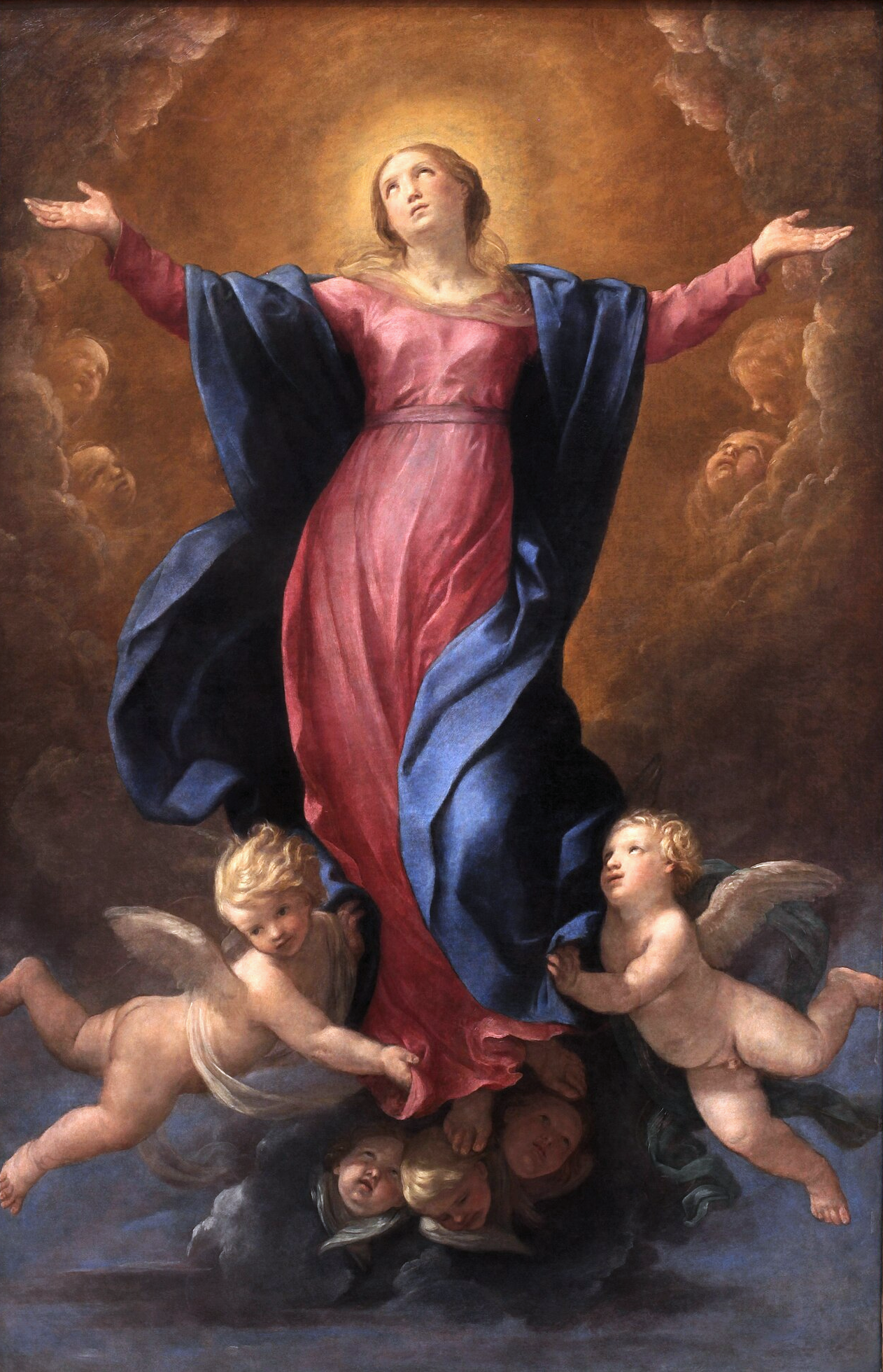
Six hundred years before Christ, when the Babylonians invaded Jerusalem, they sacked the Temple, destroyed the Temple, and the Ark of the Covenant went missing. And no Jew had seen the Ark of the Covenant until John, on the isle of Patmos, had his vision. And you can find this vision at the very end of Chapter Eleven, the Book of Revelation, and the beginning of Chapter Twelve, in which we see the Holy of Holies, Heaven, open up before John, and the first thing he sees is the Ark of the Covenant. And he describes it as a woman clothed in the sun, a crown of twelve stars around her head.
What was the Ark in the Old Testament? It was a physical container made according to very meticulous instructions. You can start in Exodus Twenty-five and go through Chapter Thirty-seven of Exodus to see how focused Our Lord is, how much importance He gives to the details of the construction and the care for the Ark. It was to be made of what was called incorruptible wood, acacia. It was covered in gold, and it was considered the holiest object on the planet. It was so holy in fact, if we remember that one passage in the Old Testament that can leave us scratching our heads, when the Jews, instead of following God’s instructions which was to carry the Ark with poles that went through certain eyelets along the side of the ark and – the Levitical priests, only the Levitical priests could touch the Ark – and they were the ones to carry it, they were going over difficult terrain, and they broke the Law; they put the ark on a cart pulled by oxen and the oxen stumble, the Ark starts to slide off of the cart and Uzzah attempts to steady the Ark, not letting it fall off the cart, but he’s not a priest, he touches it, and he dies. This was such a holy object; it demanded utter veneration.
And what did it contain? It contained, in a gold vessel, manna, the bread from Heaven. It contained the Word of the Lord, which was the Law written on stone. And it also contained Aaron’s rod, the symbol of his priesthood, which was a budding rod. Those were the objects contained in the Ark, and when it was taken out for display, it was covered in a blue cloth. Once it was completed, it was put in what was called the Tabernacle, which is a a big tent, the tent of the presence of God, and the Shekinah, the Cloud of Divine Presence, descended on it. And then, accompanied by this Divine Presence, the Jews crossed the Jordan and went into the Promised Land. It went traveling with them; if you read the books of Joshua and Judges, you can see that it’s as mobile as the people are. When they bring it into battle, victory is promised until David decides to give it a permanent resting place in Jerusalem. That’s in 2 Samuel Chapter Six. As he’s approaching Jerusalem, he brings the Ark; well, we’ll get back to that.
The Ark is then, as I mentioned before, it goes missing with the destruction of the Temple. Does anybody know where it went? Of course not. It’s in the book of Maccabees, Second Maccabees. This is why Protestants don’t know where the Ark went, because it’s in the Catholic Old Testament. And that’s also why Catholics don’t know where the Ark went, ’cause it’s in the Catholic Old Testament. But Jeremiah tells us that the Ark – he took the Ark; he was allowed to touch it, he was a priest, and he carried it up the Mount Nebo and hid it in a cave. His followers said, “We’re gonna leave markers, so we know where it is,” and they couldn’t find the place. And he said, “No, it shall remain hidden until the Glory of the Lord and the Cloud, the Shekinah, appear again.” And so, it’s missing until this vision that John has on Patmos.
Now the verb for the descent of the Holy Spirit, the Shekinah, the Cloud of Divine Presence, is ἐπισκιάζω (episkiazo); that’s an important word. We don’t see it associated with too many things except for the descent of the Shekinah, and then we see it again in Luke when Gabriel tells the Blessed Mother that the Holy Spirit will ἐπισκιάζω; he will descend upon you. So, she’s the New Ark of the Covenant. Her body is not the dwelling place of the Word of the Lord written on stone, but the true Logos of God, the Word made flesh. The New Priest who supplanted and superseded the Levitical priesthood, He is the Bread of Life, not manna, but the Eucharist.
When David brought the Ark towards Jerusalem, it says in Second Samuel Chapter Six, David arose and went to the hill country of Judah. This should sound familiar to those Catholics who actually read the New Testament, in fact, because we see the exact same formulation with the Visitation, the Gospel from today. Mary arose and went to the hill country of Judah right after this Shekinah, this descent of the Holy Spirit, the Cloud of Divine Presence upon her; the Incarnation. And then David, once he gets there, he exclaims, How can the Ark of the Lord come to me? Much like Elizabeth said, Who am I that the mother of the Lord should come to me? And David, in a sort of ecstasy, he leaps about, he dances, and he shouts, he exclaims. When the Blessed Mother, the New Ark, comes to visit her cousin Elizabeth in the hill country of Judea, John the Baptist leaps, it’s the same verb, leaps in her womb, and she’s the one who gives voice to him, and she exclaims, Blessed are you among women, and blessed is the Fruit of your womb. Who am I that the mother of my Lord should come to me? David remained for three months in the house of Obed-Edom. Mary remained in the house of Zechariah and Elizabeth for three months.
So, when John sees the Holy of Holies, the Heavens, open up before him, he’s presented with the New Ark of the New Covenant, the Blessed Virgin Mary. Now notice that when John describes her, he doesn’t describe her soul; he describes her body. She’s bodily assumed into Heaven and holier than the first Ark, not made of incorruptible acacia wood but of flesh and bone, like us, and full of grace. This also explains her Perpetual Virginity.
If Uzzah died because, not being a priest, he touched the Ark, Joseph, understanding who was living under his roof, would not touch the Blessed Mother. And it’s fitting, therefore, that Our Lord, who gave so much care – those seven chapters from Exodus – into the meticulous construction, and use, and treatment of the Old Ark of the Covenant, who, with even more care, created His own mother, would want to keep her more incorruptible than even incorruptible acacia wood; it’s fitting that He would assume her body and soul into heaven.
On a Feast Day such as this, we wonder at the glory of Our Lord. We wonder at the one who bore Him; and we thank Him. We wonder at the beauty of the Blessed Mother; and we thank Him. We wonder at her utter holiness; and we thank Him. We thank Him for the immense generosity in sharing His mother with us, allowing her to call her mother as well.
In the Name of the Father, and the Son, Holy Ghost. Amen.
~Fr. Ermatinger